In the heart of Sikatuna Village in Quezon City, a quiet street bears a name that most commuters pass by without a second thought: Karyapa Street.
To the untrained eye, it is just an urban road. But to those who listen to the whispers of our history, that name represents a monumental figure of pre-colonial Philippine power, poetry, and prophecy.
It is time we pull her story out from the shadows of colonial erasure. Meet Babaylan Karyapa, the 15th-century shaman-poetess of Bohol, and discover why her spirit still speaks to us today.
Who Was Babaylan Karyapa?
Long before the arrival of Spanish galleons, the islands were governed by a sacred balance between the physical and spiritual worlds. At the center of this balance stood the Babaylan—the shamans, healers, counselors, and spiritual leaders of the community.
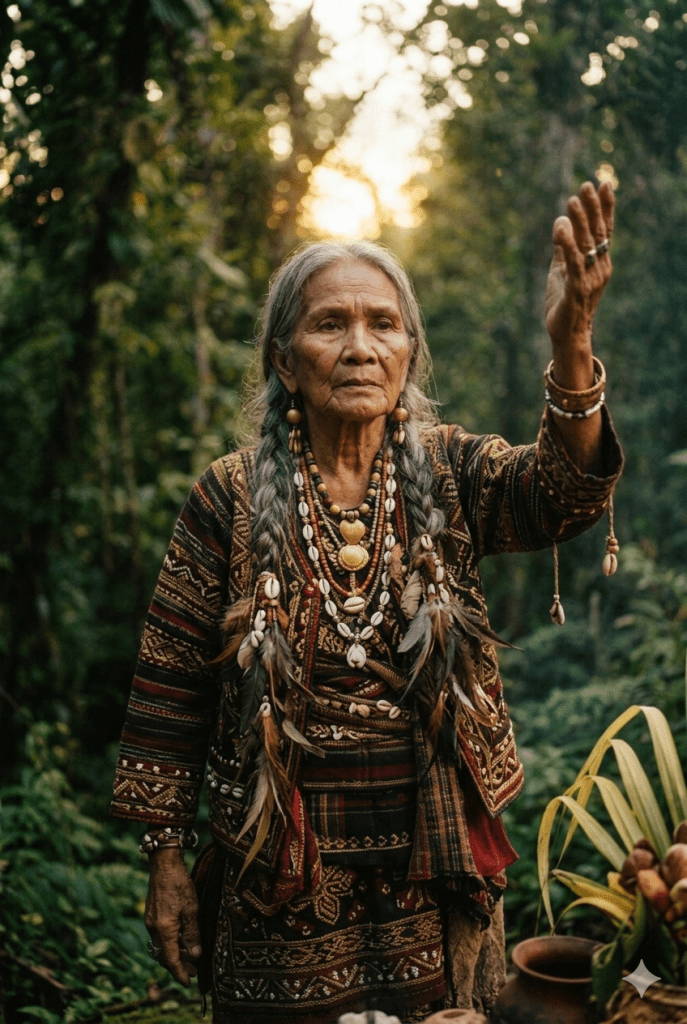
Living in the 15th to 16th century in the ancient kingdom of Bohol, Karyapa was a high priestess of exceptional renown. While she was a master of native herbalism and a bridge to the diwata (deities) and anito (ancestors), she possessed a unique brilliance: she was a master of oral poetry.
Historians and modern Boholano writers revere Karyapa as one of the first recorded native poetesses of the archipelago. She did not merely speak to her people; she channeled history, law, and divine messages through complex, rhythmic verse. To this day, proud cultural groups in Bohol affectionately refer to themselves as Kaliwat ni Karyapa (the Offspring of Karyapa).
The Vision That Changed History
Karyapa’s most defining legacy is her terrifying, accurate gift of sight.
Decades before the Spanish consolidated their power in the Visayas, Karyapa went into a trance and delivered a haunting prophecy: she foresaw a violent, overwhelming siege coming from the sea that would bring about the total destruction and downfall of the native Boholano kingdom.
In 1563, her vision became a brutal reality. The Sultanate of Ternate, allied with Portuguese colonizers, launched a massive seafaring raid on Bohol. The kingdom was decimated.
Among the wounded survivors who fled the ashes were Datu Sikatuna and Datu Sigala. Stranded, vulnerable, and stripped of their ancestral stronghold, Sikatuna eventually entered into the historic Sandugo (Blood Compact) with Spanish conquistador Miguel López de Legazpi in 1565. This fateful alliance ultimately opened the doors to over 300 years of Spanish colonization.
Karyapa did not just witness history; she saw it coming.
A Guide for Modern Followers of the “Old Path”
For centuries, colonial authorities sought to demonize the Babaylan, labeling them as witches or heretics. But you cannot kill a root. Today, a beautiful resurgence is happening. Filipinos are returning to the “Old Path”—practicing traditional healing (Hilot), respecting the land, and honoring ancestral spirits.
In modern Paganito and indigenous practices, Karyapa is not worshiped as a goddess, but revered as an Abyan—a powerful spirit guide, mentor, and guardian.
If you feel called to walk the Old Path, Karyapa’s energy can be invoked to help you in several profound ways:
Finding Your True Voice: As a master poetess, she helps practitioners find their voice, break through creative blocks, and boldly speak their truth.
Navigating Life Transitions: Because of her prophetic nature, you can petition her for clarity, heightened intuition, and protection against unseen dangers when facing major life changes.
De-colonial Reclamation: Karyapa is an anchor of pure, pre-colonial pride. Invoking her memory helps strip away the inherited shame surrounding indigenous magic, traditional arts, and native spiritual practices.
Keeping Her Memory Alive
Remembering Babaylan Karyapa is an act of revolution. It is a declaration that our history did not begin in 1521, and our spirituality did not arrive on a foreign ship.
The next time you see her name—whether on a street sign in Quezon City, in a history book, or in the quiet space of your own home altar—take a moment to honor her. Light a candle, offer clean water, and remember the poetess-prophet of Bohol who knew that even if the kingdom fell, the spirit of her people would eventually wake up.
Agod mapatnubayan tayo ng mga sinaunang magulang. (May our ancient ancestors guide us.)
🕯️ An Invocation to Babaylan Karyapa
In the quiet of this space, I call upon the winds of the South,
I call upon the earth beneath my feet, and the ancestors who walked before me.
I speak the name that survived the fires of erasure:
Babaylan Karyapa.
First Poetess of the ancient islands,
High Priestess of the sacred soils of Bohol,
Keeper of the rhythmic verses that healed the tribe,
I honor you this day.
You who spoke the laws of the diwata through song,
You who carried the history of our people in your breath,
You who looked across the vast seas and foresaw the coming shadows—
We remember your sight. We remember your sacrifice.
Though the old kingdoms fell, your roots remained deep in the earth.
Though your name was hidden, your voice still echoes in our blood.
As a follower of the Old Path, I stand here to reclaim what was never truly lost.
Babaylan Karyapa, be my Abyan. Be my guide.
- Patnubayan mo ang aking mga kamay sa paggagamot at paghilom.
(Guide my hands in medicine and healing.) - Buksan mo ang aking pandinig sa mga babala at karunungan ng kalikasan.
(Open my ears to the warnings and wisdom of nature.) - Patalasin mo ang aking dila upang mangusap lamang ng katotohanan at pag-asa.
(Sharpen my tongue to speak only of truth and hope.)
Help me strip away the colonial shame that binds my spirit.
Grant me the courage of the ancient shamans to protect my community,
And the vision of the seers to navigate the crossroads of my life.
Receive this offering of light and water as a token of my deep respect.
Walk with me on this path of remembering.
Magmula ngayon at magpakailanman, hindi ka na malilimutan.
(From now and forever, you will no longer be forgotten.)
Mayari Na! PagAsatin!
 Dambana ng Luntiang Aghama